Relocating Massive Industrial Loads Through Reliable Equipment Hauling
For project managers and plant superintendents across Canada, the relocation of massive industrial loads is a logistical puzzle with zero room for error. Whether moving a 45,000-kilogram stamping press between manufacturing facilities in Windsor or transporting an excavator to a remote pipeline site near Fort McMurray, delays cascade into labour inefficiencies and contract penalties. Restoring certainty to this process demands professional equipment hauling that respects the engineering tolerances of high-value machinery and the regulatory framework of Canadian transport.
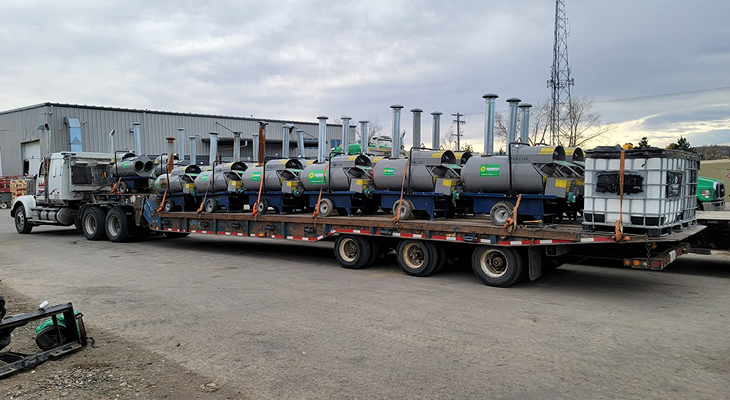
At AAA Towing, we recognise that industrial loads form the backbone of Canada’s construction, energy, and manufacturing sectors. Conventional towing solutions lack the specialised trailers and rigging expertise necessary for these complex moves. We deploy lowboy trailers, removable gooseneck (RGN) units, and heavy-duty rotators engineered for gross vehicle weights frequently exceeding 60,000 kilograms.
The Stakes of High-Volume Industrial Relocation
The financial consequences of mishandled industrial load relocation are severe. Beyond immediate repair costs, project owners face cascading liabilities:
- Idle crew wages and demobilisation expenses
- Contractually stipulated late-delivery penalties
- Potential voiding of manufacturer warranties due to improper transport
Compliance with the Canada Labour Code is non-negotiable. The Government of Canada’s Motor Carrier Safety standards, accessible through Transport Canada’s official website, explicitly outline weight corridors and securement mandates for heavy haulers. Proper equipment hauling ensures your load is moved within legal parameters while preserving your safety compliance record.
Specialised Trailers for Unique Load Geometries
Not every industrial asset fits on a standard step deck. Professional equipment hauling requires a matching of trailer type to load profile.
- Lowboy Trailers: These units feature a drop deck standing only 50 to 70 centimetres above the road surface, making them ideal for heavy machinery with high centres of gravity, such as articulated dump trucks. The reduced height improves stability on the Trans-Canada Highway.
- Removable Gooseneck (RGN) Trailers: For crawler tractors or boring machines unable to roll onto a tilted deck, the RGN is the gold standard. The front neck detaches, creating a ground-level ramp for winching non-operational units without causing undercarriage damage.
- Multi-Axle Configurations: Spreading weight across four or five axles reduces ground pressure and allows legal transport of loads approaching 100,000 kilograms.
Overcoming Canadian Seasonal and Geographic Barriers
Canada’s geography and climate demand a heavy transport partner with operational intelligence. Reliable equipment hauling during a prairie winter requires a very different approach than a summer move through the mountain passes of British Columbia.
During winter months, our protocol includes:
- Pre-trip heating of air brake reservoirs to prevent frozen valves
- Winter-grade diesel treatment for the prime mover
- Closed-cab pilot vehicles for crew protection on icy haul roads
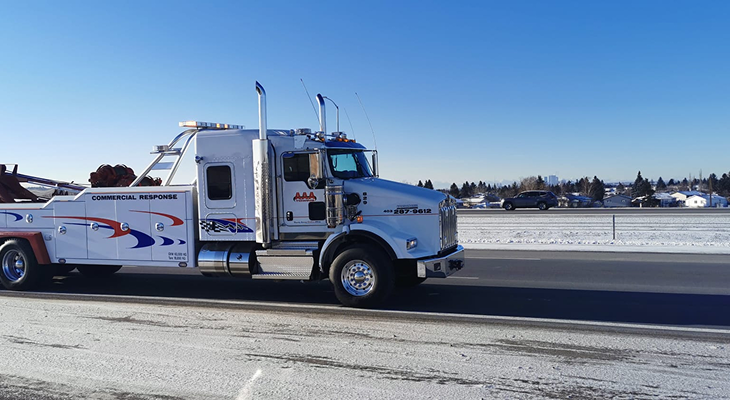
In mountainous terrain, descending the long grades of the Coquihalla Highway stresses trailer brakes to their limits. We equip every heavy haul unit with supplemental brake cooling systems and maintain two-way radio communication between the driver and the following pilot car.
Permitting and Route Planning as a Service
The greatest differentiator between amateur load movers and professional equipment hauling is the administrative discipline of permitting. Moving an oversized industrial load, any unit exceeding 2.6 metres in width or 4.15 metres in height, requires a provincial permit that defines route restrictions, travel windows, and escort requirements.
AAA Towing integrates full-service permit acquisition into our offering. Our logistics team submits route surveys, bridge clearance calculations, and traffic accommodation plans to provincial authorities before the trailer is even loaded. For moves crossing provincial borders, we coordinate with multiple jurisdictions to ensure seamless compliance. We also provide real-time GPS tracking to our clients, allowing project managers to monitor progress against scheduled arrival windows.
On-Site Rigging and Load Securement
A machine is most vulnerable during the transition from ground to trailer. Professional equipment hauling demands certified riggers who understand centre of gravity, sling angles, and lifting lug ratings.
Our technicians use load-rated shackles, synthetic slings, and G70 transport chains. We secure structural frames or manufacturer-specified lifting points identified during a pre-load inspection. Every binder is torqued to specification and re-checked after the first 50 kilometres of travel. For non-operational loads, we deploy hydraulic winch systems with wireless remote control, allowing a single technician to guide a 25,000-kilogram milling machine up an RGN ramp with millimetre precision.
Protecting Your Equipment and Your Reputation
For any contractor leasing heavy machinery, the condition of the equipment upon delivery is a matter of record. A transport provider that allows a load to shift risks causing structural deformation or hydraulic line ruptures that can void manufacturer warranties.
Choosing a professional equipment hauling provider protects your capital assets. We deliver a post-transport condition report, complete with dated photographs of all securement points and a signed bill of lading confirming zero damage at handover.
The AAA Towing Heavy Haul Protocol
When you contract us for an industrial load relocation, we follow a disciplined five-step process:
- Load Consultation: Document weight, dimensions, centre of gravity, and site access conditions.
- Route Engineering: Flag low bridges, weight-restricted roads, and seasonal road bans.
- Permitting: Apply for all provincial oversized load permits and secure pilot car services.
- Rigging and Loading: Secure the load with G70 chains and controlled winch tension.
- En Route Monitoring: Two-hour driver reports with live tracking link provided to you.
Conclusion
Your industrial machinery represents millions of dollars in capital investment and productive capacity. Every time that equipment moves between job sites, you are trusting its safety to the trailer, the rigging, and the operator. Do not entrust that responsibility to generalist tow truck providers lacking specialised heavy-haul training. AAA Towing delivers professional equipment hauling designed for the unique demands of Canadian industry. We bring lowboy trailers, certified riggers, provincial permitting expertise, and a logistics-first mindset to every industrial relocation. Ensure your next massive load arrives intact, compliant, and on time. Call us for a heavy haul consultation anywhere in Canada.