Pulling Commercial Fleets Out of Deep Mud With Unstoppable Heavy Duty Towing in Calgary
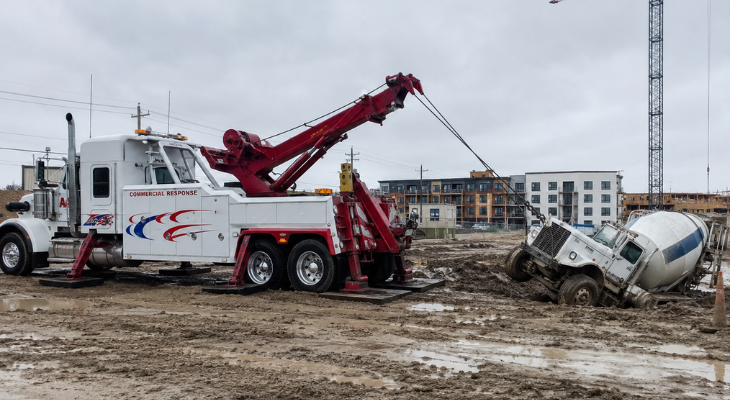
Calgary’s construction and energy sectors move millions of tonnes across active sites and rural lease roads. Between the spring thaw, summer storms, and Alberta’s clay-heavy soil, commercial vehicles frequently find themselves axle-deep in unforgiving mud.
When a loaded vacuum truck or crane carrier becomes immobilised, standard light-duty wreckers are useless. This is when professional heavy duty towing becomes an operational necessity. At AAA Towing, we specialise in commercial fleet recovery from deep mud without damaging the vehicle or terrain. Understanding why industrial recovery demands specialised equipment and rigorous protocols is essential for every fleet manager.
Why Calgary Mud Refuses to Let Go
Mud is not simply wet dirt. Saturated fine-grained soils lose almost all shear strength. When a commercial truck weighing upwards of 30,000 kilograms rests on this surface, ground pressure exceeds bearing capacity almost instantly. The vehicle sinks until the chassis contacts the substrate, creating suction that anchors the frame.
Calgary’s glacial till contains bentonite clay, which swells when wet and forms an adhesive seal around tyres and suspension components. A vehicle stuck in these conditions cannot simply drive out, every tyre rotation only deepens the ruts.
Why Calgary Mud Refuses to Let Go
Mud is not simply wet dirt. Saturated fine-grained soils lose almost all shear strength. When a commercial truck weighing upwards of 30,000 kilograms rests on this surface, ground pressure exceeds bearing capacity almost instantly. The vehicle sinks until the chassis contacts the substrate, creating suction that anchors the frame.
Calgary’s glacial till contains bentonite clay, which swells when wet and forms an adhesive seal around tyres and suspension components. A vehicle stuck in these conditions cannot simply drive out, every tyre rotation only deepens the ruts.
Light-Duty vs. Heavy-Duty: A Comparison
Attempting extraction with insufficient equipment leads to broken tow lines, damaged chassis components, and hours of wasted time. Genuine heavy duty towing requires a rotator or heavy wrecker with planetary winch systems.
| Feature | Standard Light-Duty Wrecker | Professional Heavy Duty Towing |
| Maximum Line Pull | 4 to 7 tonnes | 25 to 50+ tonnes |
| Ground Pressure Management | None | Ballasted chassis + ground mats |
| Snatch Block Capability | Limited | Multiple blocks for mechanical advantage |
| Chassis Anchor Points | Passenger vehicle only | Commercial frame rails and fifth-wheel plates |
| Mud Suction Resistance | Low (risks tow line failure) | High (engineered for clay soils) |
The Three-Step Recovery Formula Professionals Use
Before any cable is spooled out, our recovery specialists perform a systematic site assessment:
- Vehicle Evaluation: Gross vehicle weight (GVW), submersion depth, and soil type.
- Hazard Identification: Overhead utility lines and underground gas or water mains.
- Pull Force Calculation: For clay mud, resistance can equal 1.5 to 2.5 times GVW. A 25-tonne truck may require up to 62.5 tonnes of pulling force.
Federal guidelines for working near underground infrastructure are established by Transport Canada. You can review official excavation and towing safety standards on their website. AAA Towing integrates these federal safety protocols into every commercial recovery.
The Risks of Untrained Recovery Attempts
Fleet managers sometimes attempt self-recovery using another company vehicle. This practice carries substantial risks:
- Snap Loads: Recovery straps under tension can exceed 40,000 kilograms of force, turning failed components into dangerous projectiles.
- Structural Damage: Pulling from incorrect anchor points bends axle housings and damages air suspension systems.
- Personal Injury: Amateur attempts have resulted in serious injuries across southern Alberta.
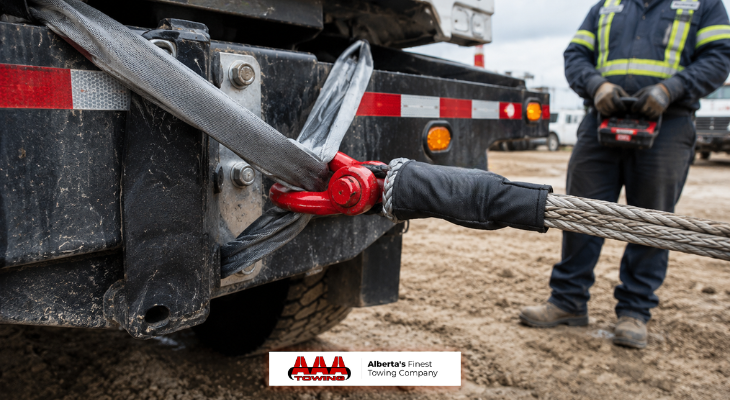
Professional off-road recovery keeps all personnel outside the minimum safe distance, uses synthetic rope to reduce stored energy, and employs remote winch controls.
Calgary’s Seasonal Recovery Calendar
Calgary’s construction calendar creates predictable periods of high demand for heavy duty towing:
- Spring Break-up (March to May): The most active season. Road bans are in effect, and off-road sites become nearly impassable.
- Summer Thunderstorms: Thirty minutes of heavy rain can turn an aggregate pad into a slick quagmire.
- Autumn Freeze-Thaw: Daytime melting and nighttime freezing can freeze-lock vehicles parked on softened ground.
Proactive Measures for Fleet Owners
While AAA Towing is always available for emergency extractions, these measures can help reduce downtime:
- Terrain Assessment: If standing water or ruts deeper than 20 centimetres exist, deploy timber mats or gravel blankets before entry.
- Adjust Tyre Pressure: Lower pressures to manufacture off-road specifications to increase the footprint and reduce ground pressure.
- Self-Recovery Gear: Equip fleet vehicles with traction boards for minimally stuck situations.
From Dispatch to Dry Ground: The Process
When you contact AAA Towing for a commercial mud recovery, our dispatcher will request the vehicle’s weight, submersion extent, and precise GPS coordinates. Upon arrival, our technicians:
- Establish an exclusion zone twice the length of the recovery cable.
- Deploy ground mats under stabilisers to prevent secondary stuck incidents.
- Attach the winch line using a bridle system to distribute the load across both frame rails.
- Perform winching in slow, controlled increments to release mud suction gradually.
Once the vehicle is free, we perform a post-recovery inspection to identify any damage sustained during the incident.
Conclusion
Deep mud is an expensive hazard for Calgary’s commercial fleets. Attempting self-recovery risks damaged vehicles, regulatory violations, and serious injury. AAA Towing delivers professional heavy duty towing services designed for Alberta’s demanding conditions. Our heavy wreckers, certified operators, and strict adherence to safety standards ensure your fleet returns to operation safely. Whether you need a complex recovery or a routine haul, contact us today for expert heavy-duty solutions tailored to your fleet.