What Happens After You Call For Heavy-Duty Towing? Step-By-Step Process
When a semi-truck breaks down on a busy highway or a fully loaded trailer tips over outside city limits, the last thing you want is confusion about what comes next. Time is money, especially in the logistics and construction industries. That’s why understanding what happens after you call for heavy-duty towing is so important.
This isn’t just about getting from point A to point B. It’s about safely recovering large vehicles, minimizing downtime, and avoiding further damage or liability. In Calgary, heavy-duty towing companies like AAA Towing are equipped to handle everything from big rig recoveries to heavy equipment hauling. But what does the process look like once you pick up the phone?
This blog explains every step from the moment your call is answered to the moment your vehicle is secured at a destination or repair facility.
Initial Call: Gathering Critical Details
The process begins with a call to a 24-hour heavy-duty towing service. During this first contact, dispatchers will ask a series of detailed questions to assess the situation and assign the right resources.
Expect to provide:
- Your exact location (GPS or closest intersection)
- Vehicle type and size (tractor-trailer, dump truck, RV, etc.)
- Nature of the problem (breakdown, rollover, accident, etc.)
- Cargo details if relevant (especially hazardous materials)
- Any immediate risks (blocked lanes, leaking fluids, road hazards)
These details help dispatchers assess urgency and send the most appropriate truck and team. A reputable company like AAA Towing maintains a full range of heavy-duty tow trucks, flatbeds, and rotators to manage any scenario.
Dispatching The Right Equipment
Once your call is logged and categorized, dispatch sends a heavy-duty towing unit tailored to your situation. This is not a one-size-fits-all operation.
Here are a few truck types that may be dispatched:
- Standard heavy tow trucks for transport trucks and buses
- Flatbeds for vehicles that require all wheels off the ground
- Rotators for recovery in complex or off-road conditions
- Wheel-lift Tow Trucks for shorter-distance transport
At this stage, GPS tracking and logistics software ensure the fastest response time possible. Dispatchers stay in contact until the crew arrives on scene.
On-Site Assessment By Towing Technicians
When the heavy-duty towing team arrives, they immediately conduct a safety and situational assessment. They’ll review:
- Vehicle positioning
- Load balance or cargo risks
- Roadway conditions
- Traffic hazards
- Weather or terrain challenges
Safety is a top priority both for the crew and for other road users. Incident management protocols may include setting up cones or warning lights, calling police assistance, or requesting additional vehicles for traffic control.
This step ensures that the recovery is not only effective but also compliant with Alberta road safety regulations.
Vehicle Recovery And Hook-Up Process
After assessing the situation, the tow crew begins the recovery or hook-up process. The method depends on the vehicle and the scenario:
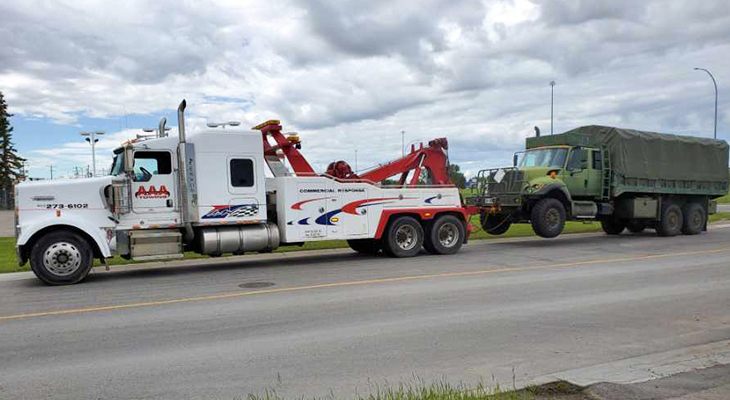
- For breakdowns: the vehicle is lifted using hydraulic arms or winches and secured for transport
- For rollovers: the team may use rotators to upright the vehicle before towing
- For off-road recoveries: winching systems are deployed to pull vehicles from ditches or rough terrain
Throughout this phase, technicians take steps to prevent further mechanical damage. Axle lifts, airbag lifts, or suspension support may be used depending on your vehicle’s design. Ensuring cargo stability is also crucial, especially for semi-trucks or trailers carrying goods.
Transport To A Safe Location
Once secured, your vehicle is transported to a location based on your request or insurance requirements. This could be:
- A repair shop or commercial garage
- Your company’s fleet yard
- A secure storage facility
- An impound or inspection yard (in the case of accident investigations)
Many towing companies, including AAA Towing, offer secure storage yards for commercial vehicles, giving clients time to coordinate repairs, cargo transfer, or insurance processing.
You’ll also receive documentation outlining the service performed, distance travelled, vehicle condition, and any required next steps.
Additional Services You May Need
Heavy-duty towing often goes hand-in-hand with related services. A professional towing provider should be ready to assist with:
- Load transfer and load shift services
- Battery boosting for large vehicles
- Winch-outs and ditch recovery
- Flat tire assistance for large fleets
- Heavy equipment hauling
These services are especially critical for logistics managers and commercial drivers operating under tight delivery schedules.
Choose AAA Towing
Not all towing companies are equipped or trained to handle heavy-duty towing. Choosing an experienced, fully insured provider ensures:
- Faster response times
- Less risk of vehicle damage
- Compliance with commercial transport regulations
- 24/7 availability
AAA Towing is a trusted provider of heavy-duty towing services in Calgary, offering 24/7 dispatch, modern equipment, and a highly trained team for all types of vehicle recovery. With over 40 years of experience, we specialize in towing commercial trucks, buses, heavy machinery, and large fleet vehicles safely and efficiently.
If you need dependable heavy-duty towing in Calgary or surrounding areas, contact us today to speak with our dispatch team.