YOUR JOB SITE IS WAITING. YOUR EQUIPMENT ISN’T MOVING. NOW WHAT?
Introduction:
A dozer sits idle. A crane needs relocation. A project deadline looms. Moving heavy equipment isn’t like calling for a tow truck. It requires expertise, permits, and the right fleet.
Your excavator finished one site yesterday. The next project starts tomorrow. But the machine is still sitting where it finished working.
Every hour your equipment sits idle costs money. Delayed start dates cascade through project timelines. Crews stand ready. Materials are ordered. But the machine that makes it all happen isn’t where it needs to be.
Here’s what project managers learn the hard way.
Moving heavy equipment involves more than hooking up a trailer and driving away. Oversized loads require permits. Weight restrictions dictate routes. Specialized trailers are needed for different equipment types. And finding a company that handles all of it? That’s where most operations hit delays.
This guide covers everything you need to know about heavy equipment hauling in Alberta.
We’ll break down equipment types, permit requirements, trailer options, and how to choose a hauler who actually delivers on time.
The problem is simple: not every towing company can move heavy equipment. The solution is knowing who has the fleet, the permits, and the experience to get your machinery where it needs to go.
WHAT SEPARATES HEAVY EQUIPMENT HAULING FROM STANDARD TOWING
Most people assume any tow truck company can move heavy machinery. That assumption costs projects days of delay.
Equipment, Expertise, And Regulations
| Requirement | Standard Towing | Heavy Equipment Hauling |
| Vehicle type | Light-duty trucks (cars, SUVs, light pickups) | Heavy-duty wreckers, lowboys, specialized trailers |
| Weight capacity | Up to 10,000 lbs | 50,000 lbs to 200,000+ lbs |
| Operator training | Basic towing certification | Specialized heavy equipment transport training |
| Permits needed | None for standard vehicles | Oversize/overweight permits for Alberta highways |
| Route planning | Direct to destination | Must plan for bridge clearances, weight restrictions |
| Insurance coverage | Standard commercial auto | High-value cargo, equipment-specific coverage |
Heavy equipment hauling is a specialized field. Companies that claim to do it without the proper fleet and training are gambling with your equipment and your timeline.
Why Experience Matters When Moving Heavy Machinery
Every piece of equipment has unique transport requirements.
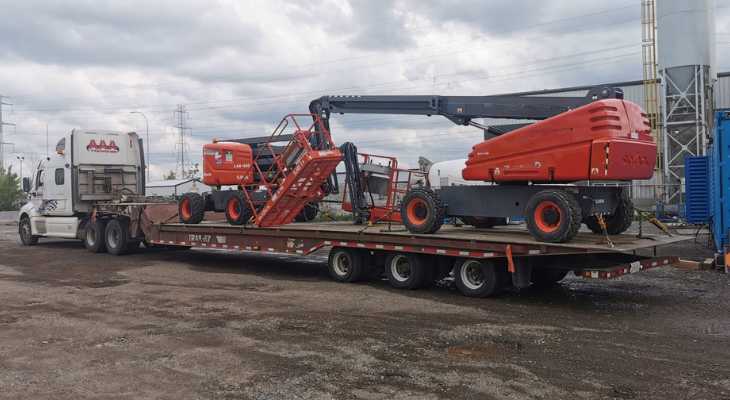
- Excavators need lowboy trailers with proper tie-down points
- Dozers require heavy-duty hauling with tracked vehicle expertise
- Cranes need disassembly coordination and specialized permits
- Combined units (truck and trailer, dump truck and pup) require knowing how to haul as a complete assembly
AAA Towing has been offering personalized heavy equipment hauling services in Calgary and surrounding areas for many years. That experience means we know how to secure each piece properly, route efficiently, and arrive on schedule.
Understanding what you’re moving determines which hauler you need and which questions you should ask before hiring it.
TYPES OF EQUIPMENT WE HAUL (AND THE RIGHT TRAILER FOR EACH)
Not all equipment moves the same way. The right trailer makes the difference between safe transport and costly damage.
Common Equipment And Transport Solutions
| Equipment Type | Typical Weight | Recommended Transport | Special Considerations |
| Skid steer | 5,000-10,000 lbs | Flatbed or tilt deck | Low clearance, easy loading |
| Mini excavator | 8,000-12,000 lbs | Flatbed with ramps | Tracked vehicles need secure tie-downs |
| Wheel loader | 15,000-30,000 lbs | Lowboy trailer | Height clearance, proper loading angle |
| Excavator (mid-size) | 20,000-40,000 lbs | Lowboy or RGN trailer | The arm must be properly positioned |
| Dozer | 30,000-50,000 lbs | Heavy-duty lowboy | Tracked vehicle expertise required |
| Large excavator | 50,000-100,000+ lbs | RGN or step deck with permits | Oversized load: route planning essential |
| Crane | 50,000-150,000+ lbs | Specialized heavy hauling | May require disassembly |
| Tractor/semi | 15,000-30,000 lbs | Heavy-duty wrecker or lowboy | May need combined unit hauling |
| Dump truck with pup | 40,000-80,000 lbs combined | Specialized heavy hauling | Must be haul as complete unit |
Combined Units — A Specialty Most Haulers Can’t Handle
A dump truck and pup trailer connected together require different expertise than hauling them each separately.
Some operations need the combined unit moved intact. That means:
- Proper trailer capacity for total combined weight
- Secure loading that maintains unit stability
- Experienced operators who understand articulated transport
AAA Towing can haul combined units efficiently and effectively. That’s the difference between a specialist and a generalist.
Equipment type determines transport method. Location determines permits, route planning, and timing.
HEAVY EQUIPMENT HAULING IN CALGARY AND BEYOND — WHAT YOU NEED TO KNOW
Alberta’s geography, weather, and regulations create unique challenges for moving heavy machinery.
Permit Requirements For Oversize And Overweight Loads
In Alberta, any load exceeding standard dimensions requires permits.
| Dimension | Standard Limit | Oversize Threshold |
| Width | 2.6 meters (8.5 feet) | Over 2.6 meters requires a permit. |
| Height | 4.15 meters (13.6 feet) | Over 4.15 meters requires route planning |
| Length (single vehicle) | 12.5 meters (41 feet) | Over 12.5 meters requires escort in some cases |
| Weight | Varies by axle configuration | Must comply with bridge formula and axle weights |
A professional heavy equipment hauling company handles all permits. You don’t need to navigate Alberta Transportation’s permitting system. We do it for you.
Route Planning For Southern Alberta
Not every road can handle heavy equipment.
Factors that determine route:
- Bridge weight ratings
- Overpass clearances
- Seasonal road bans (spring thaw restrictions)
- Construction zones
- Residential area restrictions
AAA Towing serves Calgary, Chestermere, Airdrie, Cochrane, Okotoks, High River, Black Diamond, and surrounding areas. We know the roads, the restrictions, and the best routes to get your equipment where it needs to go.
Weather Considerations In Alberta
Winter moves require different planning than summer moves.
- Frozen ground can support heavier loads (good)
- Snow and ice create safety challenges (requires experienced operators)
- Spring thaw brings road bans (timing matters)
- Summer heat affects asphalt and tire performance
An experienced heavy equipment hauler plans for weather. We don’t just check the forecast. We build contingency timelines.
With permits secured and routes planned, the actual move requires operators who understand heavy equipment, not just drivers who can hook up a trailer.
CHOOSING THE RIGHT HEAVY EQUIPMENT HAULING COMPANY
Your equipment represents a significant investment. Choosing the wrong hauler puts that investment at risk.
Questions To Ask Before Hiring
- Question #1: “What’s your experience with my specific equipment type?” Moving a crane is different from moving a dozer. Ask for examples of similar moves.
- Question #2: “Do you handle permits, or do I need to arrange them?” A full-service heavy equipment hauling company handles all permitting. If they don’t, you’re hiring a driver, not a partner.
- Question #3: “What insurance coverage do you carry?” Ask for proof of coverage. Ensure it matches the value of your equipment.
- Question #4: “How do you secure loads?” Proper tie-downs, chains, and binders matter. Ask about their process.
- Question #5: “What’s your fleet capacity?” A company with one heavy trailer can only move one piece at a time. A fleet with multiple options moves your whole operation.
Red Flags That Should Send You Elsewhere
| Red Flag | Why It Matters |
| “We can move anything” without specifics | Generalists don’t understand specialized needs |
| No heavy-duty equipment visible in the fleet. | They’ll subcontract to someone else (adds delays) |
| Unclear about permit requirements | You’ll end up arranging permits yourself |
| Vague about insurance coverage | Your equipment isn’t protected |
| No experience with Alberta regulations | Risk of fines, delays, or denied loads |
The right hauler doesn’t just move equipment. They become a trusted partner who understands your timelines and your business.
BEYOND HEAVY EQUIPMENT HAULING: COMPLETE FLEET SERVICES
A specialized hauler offers services that go beyond moving machinery from point A to point B.
Recovery Services For Disabled Equipment
- Off-road recovery for equipment stuck in mud or soft ground
- Rolled equipment recovery (cranes, excavators, dozers)
- Load transfer when cargo needs moving to another vehicle
- Scene management for accidents involving heavy machinery
Incident Management And Clean-Up
After an accident involving heavy equipment, you need more than a tow truck.
Professional incident management includes:
- Coordinating with law enforcement and emergency services
- Debris cleanup from accident scenes
- Fluid spill containment and clean-up
- Documentation for insurance claims
Crew And Equipment Coordination
Large projects sometimes require multiple pieces moved simultaneously.
AAA Towing coordinates:
- Multiple trucks for single-site moves
- Staggered arrivals for just-in-time delivery
- Return transport for equipment leaving completed sites
Whether you need a single excavator moved or an entire fleet relocated, having one company that handles it all simplifies your logistics.
WHY AAA TOWING IS ALBERTA’S CHOICE FOR HEAVY EQUIPMENT HAULING
Your equipment is the backbone of your operation. Moving it should never be an afterthought.
AAA Towing started in the early 1980s as a light-duty towing service. Over the years, we established ourselves as trailblazers for heavy-duty towing and transportation services for commercial equipment and machinery.
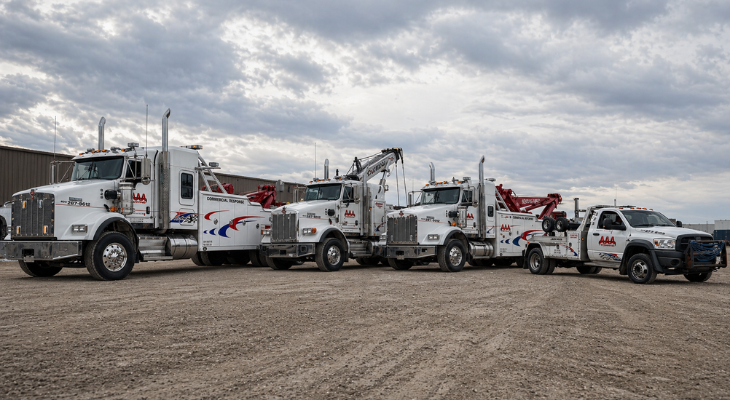
Our fleet tells the story. Over 40 vehicles ranging from 1-ton wreckers and flatbeds to specialized heavy-duty wreckers and trailers. When your equipment needs moving, we have the right rig for the job.
What that means for your operation:
- One call handles everything from permits to delivery
- Experienced operators who understand heavy equipment
- WHMIS-trained and certified drivers
- Compliance with Alberta Transportation regulations
- Insurance coverage that protects your investment
We work with all major insurance companies. That means after an incident, we handle the billing while you focus on getting back to work.
The hesitation that stops most operations from calling? “Will they show up on time? Will they know how to handle my equipment? Will I have to coordinate permits myself?”
We answer those questions with clarity. Our team of qualified and experienced drivers knows the importance of following every rule and regulation for oversized and overweight freight throughout Alberta.
Your equipment. Your timeline. Your project. One call handles it all.
Need heavy equipment moved? Call AAA Towing at 403-287-9612. We serve Calgary, Chestermere, Airdrie, Cochrane, Okotoks, High River, Black Diamond, and surrounding areas.