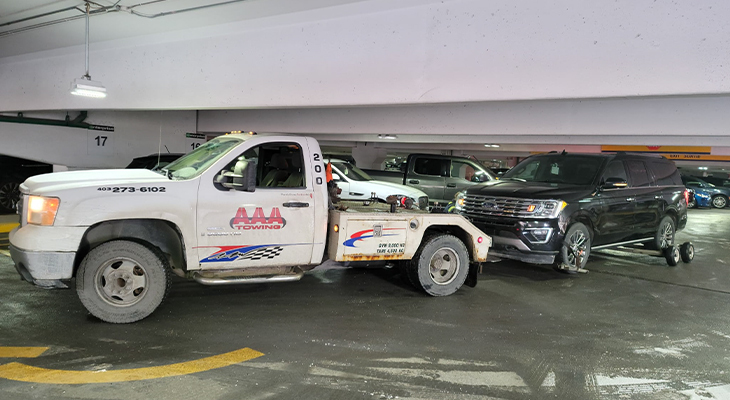
Vehicle breakdowns rarely happen in open, spacious areas. Many occur inside parkades, loading docks, underground garages, and tight commercial spaces. These situations require more than a standard tow.
If you are dealing with a breakdown in a confined structure, choosing experienced professionals for heavy-duty towing in Calgary can prevent serious damage and safety risks. Confined space recoveries demand careful planning, proper equipment, and trained operators who understand Calgary’s urban environment.
Confined recovery is not routine towing. It is a specialized operation that prioritizes safety at every step.
Confined recovery is not routine towing. It is a specialized operation that prioritizes safety at every step.
What Is a Confined Space Vehicle Recovery?
A confined space vehicle recovery takes place in an enclosed or restricted area. This may include underground parkades, tight alleyways, construction sites, or low clearance loading zones.
These environments limit movement and restrict equipment access. They also increase risks such as structural damage, ventilation concerns, and limited maneuverability.
The Government of Canada explains the seriousness of enclosed environments in workplace safety contexts. Confined spaces can be more hazardous than regular workspaces for many reasons.
Although that reference addresses occupational safety, the principle applies clearly to vehicle recovery in enclosed areas.
- Clearance and Height Restrictions
Low ceilings are common in Calgary parkades. Many underground garages limit vertical clearance to under two meters. Standard heavy-duty recovery equipment may not fit.
Operators must measure clearance before entering. Equipment such as low-profile wheel lift trucks may be required. Improper entry can damage sprinkler systems, ventilation pipes, or structural beams.
Ramp angles also create complications. Steep slopes combined with icy winter buildup increase recovery risk.
The Government of Alberta outlines structural safety principles in building standards. Buildings must be designed and constructed to safely support loads that may reasonably be expected.
Understanding load-bearing limits helps prevent structural stress during recovery.
- Limited Maneuvering Space
Confined areas offer little turning radius. Operators often work within inches of walls, pillars, or other vehicles. Precision becomes critical.
Spotters assist by guiding positioning. Clear communication reduces collision risk. Experienced operators anticipate blind spots and adjust movements carefully.
Tight access also impacts winching control. Improper alignment can cause strain on both the recovery vehicle and the disabled vehicle.
When you request recovery services in Calgary, you need operators trained specifically for these conditions. Skill matters far more in enclosed spaces than on open roadways.
- Ventilation and Air Quality Concerns
Enclosed spaces limit airflow. Running engines inside underground structures increases the accumulation of exhaust. Carbon monoxide exposure presents a serious hazard.
Operators minimize engine idle time. They use ventilation risk awareness protocols during recovery. Safety planning includes controlled operation sequences to limit emissions.
The Government of Canada highlights this risk clearly. Carbon monoxide is a colourless, odourless gas that can cause serious illness or death.
In confined recovery situations, operators must manage air exposure carefully. This is not simply about towing. It is about protecting everyone in the structure.
- Structural and Surface Stability
Underground surfaces may appear stable, yet they often conceal risks. Winter conditions in Calgary introduce ice buildup inside parkades. Moisture accumulation can create slick concrete surfaces.
Load-bearing limits vary by structure. Heavy recovery vehicles add significant weight to the floor slab. Professionals verify positioning before deploying stabilizing equipment.
Ramps add another challenge. Inclines increase traction demands during winching. Inexperienced handling can cause sliding or uncontrolled rollback.
Recovery teams adjust anchor points and wheel positioning to maintain stability. These steps prevent further damage and secondary incidents.
- Equipment Selection and Load Control
Not every recovery truck suits confined operations. Flatbeds may lack sufficient clearance in underground structures. Wheel lift systems often provide better maneuverability in tight areas.
Heavy-duty tow trucks must be configured carefully before entering. Operators consider turning radius, boom extension space, and winching alignment.
Load control is critical. The disabled vehicle must remain stable throughout extraction. Uneven weight distribution increases rollover risk.
When choosing a towing service in Calgary, verify that the company has experience with confined space operations. Proper equipment selection protects your vehicle and the surrounding structure.
Why Professional Training Is Essential
Confined recoveries require advanced training. Operators must understand structural limitations, ventilation risks, and mechanical load balance.
The Canadian Centre for Occupational Health and Safety emphasizes proper hazard control in restricted work areas. It states that before entering a confined space, all hazards must be identified and controlled.
While vehicle recovery differs from industrial entry, the hazard awareness principle remains relevant.
Proper licensing, insurance, and operator experience reduce liability. They also protect surrounding vehicles and property.
When Should You Call a Confined Space Recovery Team?
You should request specialized support if:
- Your vehicle is disabled inside a parkade.
- A commercial truck breaks down in a loading dock.
- A collision occurs in an underground structure.
- A vehicle cannot exit due to a mechanical failure in a tight alley.
In these cases, standard roadside assistance may not be enough. Specialized recovery ensures controlled extraction without escalating the problem.
Final Thoughts
Confined space vehicle recovery is a complex operation. It involves structural awareness, ventilation control, equipment precision, and trained operators.
In Calgary’s dense urban environment, these recoveries are more common than many drivers realize. Choosing professionals with proper training protects your vehicle, the structure, and everyone involved.
Safety is never optional in confined environments. It is the foundation of responsible towing.
About AAA Towing
AAA Towing provides professional heavy-duty and confined space vehicle recovery services throughout Calgary. The team understands the challenges of underground structures, tight commercial loading areas, and restricted access locations.
Operators are trained in advanced recovery techniques and equipment selection. The company maintains modern tow trucks configured for specialized urban environments.
If you require assistance in a confined space situation, contact us to ensure safe and controlled recovery.
Fast & Reliable Towing
We make sure each customer is completely satisfied before we leave the job.